Help
Coming from LastPass


Everything in your LastPass file has a place here, and your sign-in codes can live here too.
In Didji: Move to Didji
Where things are
- Vault and All items: your vault, the home list
- Passwords: logins
- Notes: Secure note records; a Passport, Driver's License or Wi-Fi password note = a template of its own; see Categories and templates
- Addresses: an address on any record, and on your own Person; see Home, and other addresses
- Payment cards and Bank accounts: Payment card and Bank account; see Payment cards
- Folders: categories and tags; see Vaults in Didji
- Favorites: Favourites, a section at the top of your list; and Pin to top for up to three on the card above it
- Shared Folders and the Sharing Center: sharing chosen records with people you've connected; Hide passwords from… is the same idea as Hide Passwords; see What is shared, and what is not
- Security Dashboard and its score: Exposure Check, with the accounts in good shape at the top; see Exposure Check
- LastPass Authenticator: sign-in codes, made and filled by Didji itself; see Sign-in codes
- Passkeys: passkeys, on the login; see Passkeys
- Password history: History on every record, and Previous passwords; see Earlier versions of a record
- Deleted items: Recently Deleted, for 30 days, at the foot of your list
- Attachments: scans, photos and PDFs inside any record; see Keeping a scan or a photograph inside a record
- Form fills: AutoFill, then Passwords, puts any value from Didji into any box; see Putting any value into any box
- Master password: nothing to remember: the key is kept in your iCloud Keychain, and Face ID opens Didji; see Where your key lives
- Emergency Access: your recovery kit, with its page for your family; see So that my family can find things
- LastPass Families: one purchase for your Family Sharing group; see Paying once
What came across
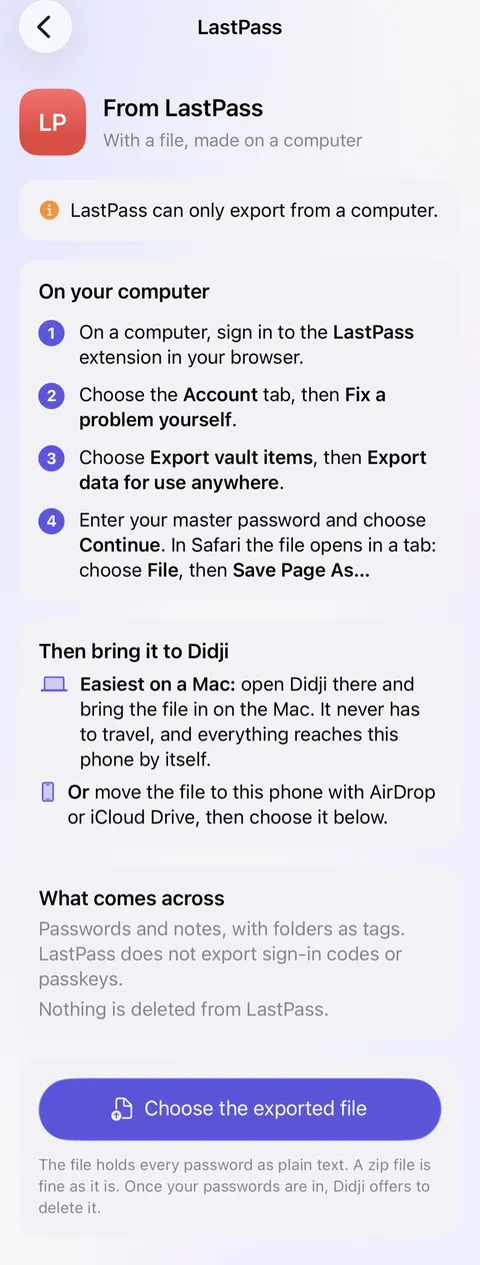
- LastPass makes its file on a computer. From it, each password comes as a login, with its folder as a tag and its favourite, and each note as a secure note.
- A Passport, Driver's License or Wi-Fi password note arrives as a secure note holding its details as text. Copy them into the right template when you're ready.
- Sign-in codes, passkeys and attachments aren't in LastPass's file. Set codes up again with Scan a QR code, and add a passkey the next time a site offers one.
- Where LastPass's file writes an & as “&”, Didji puts it back, so every password arrives as you set it.
- Nothing is copied twice. A login already in Didji with a different password is kept beside it as a second record, and Didji says so: one of the two is probably out of date.
- Everything shows under Recently added for 30 days, dated the day you moved.
- Didji offers to delete the file once it's in. Delete any other copy too: it holds every password as plain text.
New in Didji for you
- One purchase, no subscription and no account. Your vault lives on your own devices and in your own iCloud, locked before it leaves them; see Paying once.
- Sign-in codes live in the login they belong to, filled by AutoFill and shown on your Apple Watch, with no second app; see Sign-in codes.
- A page for every person, pet, car and home, with everything that belongs to them and what's due; see People & Places.
- Essentials shows what people usually keep, and which of it isn't in Didji yet; see Essentials.
- Moved house or changed your email? I’m changing this everywhere finds every record holding the old one and takes you through them; see Changing an address, a number or an email.
- Search reads inside your scans and PDFs, so a word printed on a letter is found too; see Finding things.
- Private Photos keeps photographs and videos in the vault, away from your camera roll; see Private Photos.
- Templates researched for your own country, with reminders before a passport or an MOT runs out; see Categories and templates.
What works differently
- Sharing is with people, a record at a time: a shared record goes only to someone you've connected with in Didji, and only you can change it. The people you share with don't need to buy Didji; see What is shared, and what is not.
- Exposure Check looks for your passwords themselves in known breaches, and never sends your email address anywhere to be checked; see What leaves your device.
- The way in for your family is your recovery kit on paper, with its page for them, rather than a request and a wait; see So that my family can find things.
- Didji is for iPhone, iPad and Mac, and fills through Apple's own AutoFill rather than a browser extension; see Filling in passwords for you.
- Nobody, us included, can reset your way in. Your recovery kit is the way back; see What we can't do for you.
See also
Still stuck?
Write to us at hello@didji.app, and tell us which device you’re using if you can.
Never send a password or your recovery code to anybody, us included. What we can’t do for you.